Key Takeaways
- Valves control fluid flow in hydraulic systems for construction, agriculture, and heavy machinery
- Eight core valve types serve distinct functions—from complete shut-off to precision flow control
- Shut-off valves start or stop flow; regulating valves adjust flow rate and pressure
- Selection depends on application requirements, pressure rating, and maintenance needs
- Choosing the right valve prevents equipment damage and costly downtime
What Are Industrial Valves?
Industrial valves control the flow of fluids—liquids, gases, or slurries—through pipelines. These mechanical devices start, stop, regulate, or direct flow by opening, closing, or partially obstructing passageways.
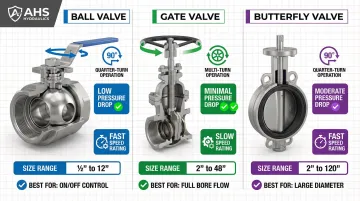
These critical components come in various designs to suit different industrial applications. Sizes range from small 1/2" valves for instrumentation lines to massive 48" valves for main water supply systems. Materials include brass for water service, bronze for marine applications, stainless steel for corrosive environments, and cast iron or cast steel for high-pressure steam and petroleum applications.
Pressure ratings span from low-pressure applications under 150 PSI to extreme high-pressure systems exceeding 3,000 PSI.
Why Are Industrial Valves Important in Industrial Operations?
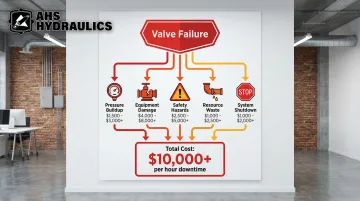
Industrial valves control flow, pressure, and direction in hydraulic and process systems—directly impacting efficiency, safety, and equipment life. The stakes are high: unplanned downtime costs facilities a minimum of $10,000 per hour.
Global process industries lose approximately $20 billion annually due to unscheduled interruptions, many stemming from valve failures or improper flow control.
Without proper valves, industrial operations face serious consequences:
- Dangerous pressure buildup from uncontrolled flow
- Overpressure and water hammer damage to pumps, cylinders, and hoses
- Catastrophic failures that risk worker safety
- Resource waste through leakage and inefficient flow
- Full system shutdowns required for routine maintenance
These risks are especially critical in heavy machinery operations. Construction equipment, agricultural machinery, and firewood processing systems all depend on reliable valves to handle high-pressure hydraulic demands safely.
The Williams Geismar incident in 2013, which killed two workers, shows how improper isolation and relief valve management leads to catastrophic overpressure failures.
Types of Industrial Valves
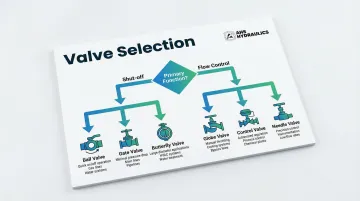
Industrial valves fall into two main categories: shut-off valves for starting and stopping flow, and regulating valves for controlling flow rate and pressure. Each valve type has distinct design features, operating mechanisms, and ideal applications. Selecting the wrong valve type can lead to premature failure, safety hazards, and thousands of dollars in downtime—especially in hydraulic systems where pressure spikes and flow control are critical.
Ball Valves
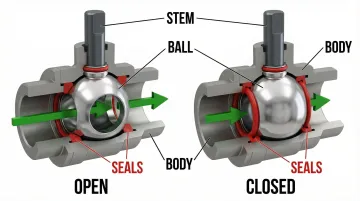
Ball valves use a spherical ball with a hole through its center to control flow. When the handle turns 90°, the ball rotates to align the hole with the pipeline (open) or perpendicular to it (closed).
This quarter-turn design provides the fastest shut-off compared to multi-turn valves like gate or globe valves. Ball valves offer tight sealing with minimal pressure drop and require significantly less operating torque than other valve types. Industrial ball valves conform to ASME B16.34 and API 6D standards, with pressure ratings from Class 150 to Class 2500 and temperature capabilities from -50°F to 1,000°F.
Common applications include:
- On/off operation requiring quick shut-off
- Systems handling clean liquids or gases
- Water supply lines and fuel systems
- Hydraulic systems in heavy machinery where tight shut-off is critical
Advantages:
- Excellent sealing capability with bubble-tight performance
- Low operating torque for easy manual operation
- Compact design requiring minimal installation space
- Long service life with minimal maintenance
- High-pressure capability up to 5,000 PSI in industrial models
Drawbacks: Not ideal for throttling applications, as partial opening causes seat damage. The ball design can trap fluids when closed, creating potential contamination issues. Larger sizes become expensive compared to other valve types.
Gate Valves
Gate valves use a wedge-shaped gate that moves perpendicular to the flow path to start or stop flow. Turning the handwheel multiple times raises or lowers the gate, fully opening or closing the flow path.
This multi-turn design is engineered for isolation service. Gate valves provide minimal flow restriction when fully open due to their straight-through flow path. Cast steel gate valves rated Class 600 handle 1,480 PSI at standard temperatures, making them suitable for high-pressure applications. Unlike globe valves, they handle strictly fully open or fully closed positions—never for throttling.
Typical uses:
- Applications requiring full flow with minimal pressure drop
- Infrequent operation and isolation service
- Main water lines and process plant isolation points
- Systems where the valve stays fully open or fully closed
Advantages:
- Minimal pressure drop when fully open
- Bi-directional flow capability
- Suitable for high-temperature and high-pressure applications
- Full-bore design maximizes flow efficiency
Drawbacks: Slow operation requires multiple turns. Not suitable for throttling—partial opening causes excessive vibration and seat wear, leading to premature failure and leakage. Rising stem design requires more installation space.
Globe Valves
Globe valves feature a movable disc that sits against a stationary ring seat. The disc moves perpendicular to the seat, and turning the handwheel raises or lowers the disc.
This creates a variable gap between disc and seat, allowing precise control of flow rate. Unlike gate valves designed for on/off service only, globe valves excel at throttling and flow regulation. The internal design creates an S-shaped flow path that provides excellent control but results in higher pressure drop compared to gate valves.
Ideal for:
- Applications requiring flow regulation and throttling
- Systems needing frequent operation
- Cooling water systems and chemical feed lines
- Boiler applications where precise control is essential
Advantages:
- Excellent throttling capability with precise flow control
- Good shut-off characteristics for tight sealing
- Shorter stroke compared to gate valves for faster operation
- Engineered specifically for regulating flow
Drawbacks: Higher pressure drop compared to gate valves increases energy costs. Flow is unidirectional—valves must be installed in correct orientation. More expensive than basic shut-off valves due to complex internal design.
Butterfly Valves
Butterfly valves use a circular disc mounted on a rotating shaft to control flow. Rotating the handle 90° turns the disc from parallel to the flow (fully open) to perpendicular (fully closed).
This quarter-turn design combines speed with simplicity. Butterfly valves offer the most compact and lightweight design compared to gate or globe valves of equivalent size. In high-volume flows, butterfly valves can reduce pressure loss by approximately 70% compared to traditional gate valves, making them ideal for large-diameter applications where weight and space are concerns.
Common in:
- Large pipeline applications (4" diameter and above)
- Systems requiring quick shut-off
- Water treatment plants and HVAC systems
- Large-scale irrigation where space and weight savings matter
Advantages:
- Compact design with minimal footprint
- Lightweight construction reduces installation costs
- Fast operation with 90° turn
- Cost-effective for large sizes
- Easy maintenance with minimal parts
Drawbacks: Higher pressure drop than gate valves. Limited pressure ratings, typically 150-250 PSI for ductile iron models. The disc remains in the flow path even when fully open, creating some obstruction.
Check Valves
Check valves automatically allow flow in one direction only and prevent backflow without manual operation. Flow pressure opens the valve, while reverse flow or gravity automatically closes it using internal components like a disc, ball, or flapper.
These are the only valves that operate automatically based on flow direction, requiring no actuator or manual operation. They serve as critical safety devices protecting pumps and equipment from reverse flow damage—essential in hydraulic systems powering firewood processors, log splitters, and construction equipment where sudden pressure reversals can damage expensive hydraulic pumps.
Essential for:
- Preventing backflow in pump discharge lines
- Protecting equipment from reverse flow damage
- Maintaining prime in pump systems
- Compressor discharge lines and wastewater systems
Advantages:
- Automatic operation requires no power or manual intervention
- Prevents water hammer and backflow
- Protects pumps and equipment from damage
- Available in various designs (swing check, lift check, dual-plate) for different applications
Drawbacks: Not suitable for systems with frequent flow reversals, which causes chatter and wear. Swing check valves can cause significant water hammer—in one municipal pumping station study, a swing check valve caused a pressure surge 47 meters above steady state, while a nozzle check valve limited the surge to only 8 meters. Requires minimum flow velocity to function properly.
Pressure Relief Valves
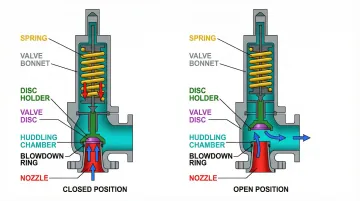
Pressure relief valves are safety devices that automatically open when system pressure exceeds a preset limit, releasing fluid to prevent equipment damage or catastrophic failure.
A spring-loaded mechanism holds the valve closed until pressure overcomes the spring force. The valve then opens to discharge excess pressure, automatically reseating when pressure drops to safe levels. These are the only valves designed specifically for safety and overpressure protection, operating automatically without manual intervention. ASME BPVC Section VIII mandates set pressure tolerances of ±3% for systems above 70 PSI.
Critical in:
- Protecting pressure vessels and boilers
- Hydraulic systems in heavy machinery
- Compressed air systems
- Any pressurized system where overpressure could cause equipment damage or safety hazards
Advantages:
- Automatic overpressure protection prevents catastrophic failures
- Meets safety code requirements mandated by law
- Available in various set pressures and discharge capacities
- Self-resetting design requires no manual intervention
Drawbacks: Requires periodic testing and recalibration—power boilers under 400 PSI need manual checks every year and pressure tests every 3 years. Can chatter if operating near set pressure. Discharge must be properly routed to safe location. Not suitable for flow control applications.
Control Valves
Control valves regulate flow rate, pressure, or temperature by adjusting the valve opening in response to signals from a control system.
An actuator (pneumatic, electric, or hydraulic) positions the valve based on input from sensors and controllers, providing precise, automatic control of process variables. These sophisticated valves integrate with control systems for automated process control rather than simple manual on/off operation. The process automation control valve market is forecast to reach $11.2 billion by 2030, driven by IIoT adoption for real-time monitoring.
Best for:
- Process industries requiring precise flow control
- Automated systems with remote operation needs
- Chemical processing and power generation
- Water treatment and automated manufacturing
Advantages:
- Precise flow regulation maintains consistent process conditions
- Automatic operation eliminates manual intervention
- Integration with control systems enables advanced automation
- Remote operation capability improves safety
- Reduces labor costs through automation
Drawbacks: Higher initial cost compared to manual valves. Requires power source for actuator operation. More complex maintenance requiring specialized knowledge. Potential for control system failures affecting operation.
Needle Valves
Needle valves use a long, tapered needle-shaped plug to provide extremely fine flow control. The threaded stem allows very gradual adjustment of the needle position relative to the seat.
This enables precise flow regulation in small increments with many thread turns required for full travel. Needle valves offer the finest flow control of any manual valve type. Typical flow coefficients (Cv) range from 0.09 to 1.80 for orifice sizes between 0.080 and 0.375 inches, providing much more precise adjustment than globe or ball valves.
Designed for:
- Instrumentation systems and gauge isolation
- Sampling systems requiring precise flow metering
- Analytical instrument feed lines
- Calibration systems where exact control is critical
Advantages:
- Exceptional flow control precision with incremental adjustment
- Excellent shut-off capability
- High-pressure capability up to 10,000 PSI in severe service models
- Bi-directional flow capability
Drawbacks: Small orifice size limits flow capacity to low-flow applications. Slow operation due to many turns required for full travel. Prone to clogging with dirty fluids. Not suitable for high-flow applications.
How to Choose the Right Industrial Valve
Selecting the right valve depends on matching valve characteristics to your specific application requirements. There's no universal "best" valve—success comes from understanding your system's demands and choosing components that meet those exact needs.
Key Selection Factors:
Start by evaluating these critical aspects of your hydraulic or industrial system:
- Application purpose - Determine whether you need shut-off capability or flow control. Ball and gate valves excel at isolation, while globe and control valves handle throttling.
- Fluid characteristics - Clean fluids work with most valve types, but dirty or fibrous fluids require specialized designs. Corrosive fluids demand stainless steel or special alloy construction.
- Operating conditions - Verify that pressure and temperature ratings match or exceed your system requirements. Operating valves beyond rated limits risks system failure and voided warranties.
Operational requirements:
- Frequency of operation (daily vs. infrequent)
- Manual vs. automated operation needs
- Required flow capacity and acceptable pressure drop
- Space constraints and installation orientation
Material compatibility: Select valve body and trim materials compatible with your fluid:
- Brass for water service
- Stainless steel for corrosive fluids
- Cast steel for high-pressure steam applications
In hydraulic systems for heavy machinery, agricultural equipment, and firewood processing operations, valve selection directly impacts uptime. Quality hydraulic valves and actuators handle demanding pressure cycles without premature wear, reducing maintenance intervals and preventing costly breakdowns during peak operation.
Common Mistakes When Selecting Industrial Valves
Using gate valves for throttling — Operating gate valves in partially open positions causes excessive wear on the gate and seat, leading to premature failure and leakage. Gate valves are designed strictly to operate fully open or fully closed.
Use globe or control valves for flow regulation instead.
Oversizing valves — Selecting valves significantly larger than required leads to poor control, increased cost, and operational problems. A case study revealed a 12-inch butterfly valve used for bypass had a flow coefficient of 4,563 gpm compared to the control valve's 495 gpm, creating severe controllability issues.
Oversized valves also cause hunting and increased wear.
Ignoring pressure and temperature ratings — Operating valves beyond their rated limits risks catastrophic failure and safety hazards. Always verify ratings match or exceed operating conditions.
Ensure materials comply with service requirements such as NACE MR0175 for sour service environments.
Frequently Asked Questions
What are the different types of industrial valves?
The main types include ball valves (quick on/off), gate valves (isolation), globe valves (throttling), butterfly valves (large diameter control), check valves (backflow prevention), pressure relief valves (overpressure protection), control valves (automated regulation), and needle valves (precision control).
What are the 5 different valves and their functions?
The five most common are: (1) Ball valves for fast shut-off, (2) Gate valves for isolation with minimal pressure drop, (3) Globe valves for flow regulation, (4) Butterfly valves for large-diameter control, and (5) Check valves for backflow prevention.
What is the most common valve used in industry?
Ball valves and gate valves are the most widely used. Ball valves dominate applications requiring frequent operation and quick shut-off, while gate valves remain common for isolation service in larger pipelines where infrequent operation and minimal pressure drop are priorities.
Can industrial valves be automated?
Yes, most industrial valves can be automated using pneumatic, electric, or hydraulic actuators that control valve operation based on system signals. This enables remote control and integration with automated systems.
How do I know when an industrial valve needs replacement?
Warning signs include visible leakage around the valve body or stem, difficulty operating the valve, inability to fully close, corrosion or physical damage to the valve body, and failure to maintain pressure when closed.
What maintenance do industrial valves require?
Regular maintenance includes periodic inspection for leaks and corrosion, lubrication of stem threads and packing, exercising infrequently used valves to prevent seizing, tightening packing glands as needed, and testing pressure relief valves per code requirements.