Introduction
Choosing the wrong valve for your hydraulic system can cost thousands in downtime, energy waste, and premature component failure. Whether you're running construction equipment, agricultural machinery, or firewood processors, the valve decision directly impacts precision, maintenance schedules, and operating costs.
The performance gap is significant. Servo valves require 70 bar (1000 psi) pressure drops and ISO 16/13/10 fluid cleanliness, while proportional valves operate at just 10 bar (145 psi) with ISO 18/16/13 filtration—differences that dramatically affect initial investment, energy consumption, and long-term operational costs.
Both valve types control flow and pressure, but they differ fundamentally in cost, performance, and maintenance complexity.
This guide helps you match valve capabilities to your actual application needs—avoiding both over-specification (wasted budget) and under-specification (performance failures).
Key Takeaways
- Servo valves: Mechanical feedback delivers sub-5ms response times but requires expensive filtration and causes 1000 psi pressure drops
- Proportional valves: Electronic feedback operates at 145 psi pressure drops, costs 50-70% less, and modern versions match servo accuracy
- Best for precision work: Aerospace, CNC machining, and applications needing extreme accuracy favor servo valves
- Best for heavy equipment: Construction, agriculture, and cost-sensitive operations benefit from proportional valves
- Key difference: Spool overlap (servo <3%, proportional >3%) and feedback mechanism determine performance
Servo vs Proportional Valves: Quick Comparison
Understanding the differences between servo and proportional valves helps you choose the right hydraulic control system for your application. This comparison covers performance specifications, cost factors, and practical maintenance considerations.
| Feature | Servo Valves | Proportional Valves |
|---|---|---|
| Initial Cost | $3,200+ (high-performance models) | $428-$1,205 (standard to OBE models) |
| Pressure Drop | 70 bar (1,000 psi) | 10 bar (145-150 psi) |
| Response Time | <4 ms to <16 ms (standard to high-response) | 15-20 ms (standard); <3.5-10 ms (high-response) |
| Frequency Response | 45-450 Hz (-3dB point) | 20-50 Hz (standard); up to 350 Hz (high-response) |
| Hysteresis | ≤3.0% typical | ≤0.2% (standard); <0.05% (high-response) |
| Filtration Required | ISO 16/13/10 (β5 ≥ 75) | ISO 18/16/13 (β10 ≥ 75) |
| Feedback Mechanism | Internal mechanical (flapper-spool linkage) | External electronic (LVDT with OBE) |
| Spool Overlap | <3% (zero-lap or axis cut) | >3% (standard); zero-lap available in high-response |
| Maintenance | Specialist OEM service only (e.g., Moog authorized centers) | Broader service network, easier field maintenance |
| Typical Applications | Aerospace flight controls, CNC machining, automotive safety systems | Construction equipment, agricultural machinery, material handling, firewood processors |
| Energy Efficiency | Lower (high pressure drop = heat generation) | Higher (lower pressure drop reduces energy loss) |
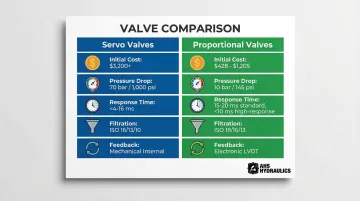
The cost difference between these valve types reflects their fundamental design philosophies. Servo valves prioritize extreme precision and speed, while proportional valves balance performance with practical considerations like maintenance accessibility and energy consumption.
Pressure drop represents one of the most significant operational differences. Servo valves' 70-bar drop generates substantial heat, requiring larger cooling systems and consuming more energy. Proportional valves operate at 10 bar, reducing thermal stress on your hydraulic system and lowering operating costs over time.
For maintenance planning, servo valves require specialized OEM service facilities with trained technicians. Proportional valves offer broader service options and simpler field repairs, reducing downtime in remote or high-demand environments.
Key Decision Factors:
- Choose servo valves when microsecond response times are critical, like CNC machining centers or aerospace applications requiring sub-millisecond precision
- Choose proportional valves for construction equipment, agricultural machinery, and material handling systems where reliability, serviceability, and energy efficiency outweigh extreme speed requirements
- Consider high-response proportional valves as a middle ground, offering response times under 10 ms at half the cost of servo systems
- Factor filtration costs into total ownership—servo valves require cleaner fluid (ISO 16/13/10) than proportional valves (ISO 18/16/13), increasing filter maintenance expenses
What is a Servo Valve?
Servo valves are continuously variable, electrically modulated directional control valves featuring internal mechanical feedback and typically less than 3% center overlap.
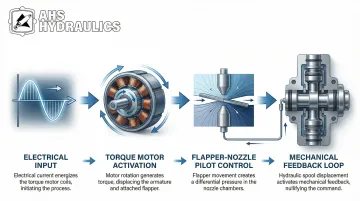
They represent the precision standard in hydraulic control, using a torque motor and flapper-style pilot valve design where a mechanical linkage between the spool and flapper creates inherent feedback that maintains accurate flow regardless of pressure variations.
The torque motor converts electrical current into rotational force that pivots a flapper between two nozzles. This creates a differential pressure that shifts the main spool. As the spool moves, a mechanical feedback wire physically repositions the flapper, creating a self-correcting loop that doesn't rely on electronics—the valve "knows" its position through mechanical geometry alone.
Performance characteristics that set servo valves apart include:
- Frequency response: Standard models achieve -3dB at ~45 Hz, high-response models reach 140 Hz, and very high-response designs hit 450 Hz
- Step response: Ranges from <4 ms (very high response) to <16 ms (standard response) for 0-100% stroke
- Hysteresis: Typically ≤3.0% of rated signal
- Threshold sensitivity: ≤0.5% of rated signal
These performance levels come with demanding operational requirements.
The 70 bar (1,000 psi) pressure drop requirement isn't arbitrary—it maintains control authority (stiffness) against load disturbances. This ensures the valve can precisely regulate flow even when downstream pressure fluctuates.
However, this high pressure drop converts substantial hydraulic power directly into heat.
Extreme filtration demands stem from the nozzle-flapper pilot stage's tiny clearances. ISO 16/13/10 cleanliness means fewer than 1,300 particles per 100ml at 4 microns—contamination levels that require β5 ≥ 75 filtration (5 µm absolute).
Operating a servo valve with inadequate filtration rapidly damages the pilot stage, causing erratic control and eventual failure.
These demanding requirements drive substantial cost implications.
High-performance servo valves cost $3,200 or more, compared to $428-$1,205 for proportional valves.
Beyond purchase price, servo valves require specialist maintenance—Moog explicitly states they're the only authorized repair center for their servo valves, creating a captive service market with higher repair costs and longer lead times than proportional valves serviceable by general hydraulic shops.
Use Cases of Servo Valves
Aerospace applications demand servo valves for flight control surfaces, landing gear actuation, and flight simulators. These systems require sub-millisecond response times where any delay could compromise safety. Landing gear systems, for example, must extend and lock reliably under varying aerodynamic loads and aircraft attitudes—conditions where servo valves' mechanical feedback and high control authority are essential.
CNC machining centers use servo valves for tool positioning where micron-level tolerances determine part quality. A study on high-frequency position servo control demonstrated that hydraulic actuators with valve dynamic compensation achieve positioning accuracy within 0.1mm even at frequencies above 100 Hz—precision unattainable with standard proportional valves.
Automotive safety systems including ABS and advanced active suspension rely on servo valves' rapid response. Active suspension systems actuate at frequencies exceeding 100 Hz to counteract road disturbances in real-time, requiring the 140-450 Hz frequency response only servo valves provide.
The common thread: applications where microsecond response times and sub-millimeter positioning accuracy directly impact safety, quality, or regulatory compliance—scenarios that justify servo valves' premium cost and demanding maintenance.
What is a Proportional Valve?
Proportional valves are continuously variable, electrically modulated valves with more than 3% center overlap, using electronic feedback (LVDT) rather than mechanical feedback. Unlike servo valves' mechanical linkage, proportional valves monitor spool position electronically and adjust PWM (pulse-width modulation) output to maintain desired position despite flow forces.
Older PWM-based designs with simple metering notches have evolved into sophisticated closed-loop systems with onboard electronics (OBE) that rival servo performance. Modern high-response proportional valves like the Parker DFplus achieve <3.5 ms step response and <0.05% hysteresis—specifications that overlap with servo valve territory.
The LVDT (Linear Variable Differential Transformer) feedback mechanism continuously monitors spool position and produces an electrical signal proportional to spool displacement. Onboard electronics compare this signal to the command input and adjust solenoid current via PWM to correct positioning errors.
This closed-loop electronic feedback compensates for flow forces, friction, and pressure variations that would otherwise cause positioning errors.
Key operational advantages include:
- Lower pressure drop: 10 bar (145-150 psi) vs 1,000 psi reduces energy consumption and heat generation significantly
- Less demanding filtration: ISO 18/16/13 vs ISO 16/13/10 lowers filtration system costs and maintenance frequency
- Cost effectiveness: $428 for standard models to $1,205 for OBE-equipped versions—50-70% less than servo valves
- Broader service network: Not restricted to OEM-only maintenance, reducing downtime and repair costs
High-response proportional valves have narrowed the performance gap dramatically. The Parker DFplus achieves frequency response up to 350 Hz (-3dB point) and hysteresis <0.05%, while the Bosch Rexroth 4WRPEH delivers ≤10 ms step response with <0.1% hysteresis. These specifications approach or match standard servo valve performance at a fraction of the cost.
These performance characteristics make proportional valves ideal for applications requiring variable control without servo-level precision costs.

Use Cases of Proportional Valves
Construction equipment including excavators, loaders, and backhoes relies heavily on proportional valves for boom, bucket, and implement control. These applications need smooth, variable control for operator comfort and productivity but don't require servo-level precision.
A research study on excavator hydraulics showed that electro-hydraulic proportional systems improved energy efficiency by 119% compared to traditional separate metering valve systems.
Agricultural machinery such as harvesters, tractors, and combines uses proportional valves for implement positioning, header height control, and hydraulic drive functions. The lower pressure drop (145 psi vs 1,000 psi) translates directly to fuel savings in mobile equipment where engine power drives hydraulic pumps.
Material handling equipment including forklifts and telehandlers benefits from proportional valves' smooth acceleration and deceleration for load lifting and lowering. The electronic feedback provides consistent control regardless of load weight, improving operator productivity without the filtration infrastructure servo valves demand.
Firewood processing equipment represents an ideal proportional valve application. Equipment like hydraulic log splitters and processors use proportional control for cylinder actuation, providing variable splitting speed and force control.
The robust construction and contamination tolerance suit outdoor forestry environments where maintaining ISO 16/13/10 cleanliness would be impractical. HydraWolf Hydraulics manufactures hydraulic components specifically for these demanding applications.
The selection rationale centers on applications needing variable control and good accuracy but where extreme precision doesn't justify servo valve costs or where field conditions can't accommodate strict filtration requirements.
Servo vs Proportional: Which is Better for Your Application?
Decision Framework
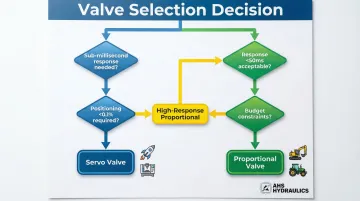
Consider these factors when choosing between servo and proportional valves:
- Required accuracy level: Sub-0.1% positioning accuracy demands servo or high-response proportional valves
- Response time needs: Applications requiring <5 ms step response need servo or premium proportional valves
- Budget constraints: Total cost of ownership including filtration, maintenance, and energy consumption
- Maintenance capabilities: In-house hydraulic expertise vs. reliance on specialist OEM service
- Filtration infrastructure: Existing capability to maintain ISO 16/13/10 vs. ISO 18/16/13 cleanliness
- Pressure drop tolerance: Energy efficiency priorities and cooling system capacity
When to Choose Servo Valves
Servo valves are the right choice when:
- Sub-millisecond response times are safety-critical (aerospace, medical devices)
- You need positioning accuracy below 0.1% for product quality (precision CNC, injection molding)
- You can maintain ISO 16/13/10 filtration consistently
- Budget allows for $3,200+ initial cost plus specialist OEM maintenance
- High pressure drop (1,000 psi) is acceptable given system design
- Application operates in controlled environments where contamination is manageable
When to Choose Proportional Valves
Proportional valves work best when:
- Good variable control is sufficient (construction, agriculture, material handling)
- Slightly lower accuracy is acceptable (0.2% vs. 0.1% hysteresis)
- Energy efficiency matters—lower pressure drop (145 psi) reduces power consumption and heat
- You want to minimize maintenance costs
- Filtration infrastructure is limited or field conditions make extreme cleanliness difficult
- Broader service network availability reduces downtime risk
The Narrowing Performance Gap
Modern high-response proportional valves with closed-loop OBE control have narrowed the performance gap substantially. The Parker DFplus with 350 Hz frequency response and <0.05% hysteresis rivals many servo valves at a fraction of the cost.
This makes proportional valves suitable for applications that historically required servo valves—except where absolute extreme precision or regulatory requirements mandate servo technology.
Many systems use both valve types strategically. Servo valves handle critical precision functions like tool positioning and safety-critical actuation, while proportional valves manage less demanding tasks like clamping and auxiliary functions. This optimizes performance while controlling costs.
Specifications to Request from Manufacturers
When evaluating valves, request these specifications from manufacturers:
- Frequency response (-3dB point and 90° phase lag)
- Step response time (0-100% stroke in milliseconds)
- Hysteresis percentage (positioning repeatability)
- Accuracy and linearity (deviation from ideal flow curve)
- Pressure drop curves at various spool positions
- Filtration requirements (ISO cleanliness code and beta ratio)
- Spool overlap specification (zero-lap, axis cut, or positive overlap)
Real-World Applications and Case Studies
A construction equipment manufacturer faced a decision when upgrading hydraulic control for excavator boom cylinders. The application required variable speed control for smooth operation and positioning accuracy within ±5mm for attachment work.
The team evaluated servo valves first. These offered <10 ms response and 0.1% accuracy but required ISO 16/13/10 filtration—challenging in dusty construction environments.
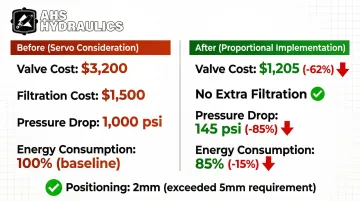
Initial valve cost was $3,200 per unit, plus $1,500 for upgraded filtration systems. The 1,000 psi pressure drop would generate significant heat, requiring larger cooling capacity.
High-response proportional valves (Bosch Rexroth 4WRPEH series) with OBE and LVDT feedback delivered 10 ms step response and 0.2% hysteresis—sufficient for the ±5mm positioning requirement.
Operating at 145 psi pressure drop reduced energy consumption by roughly 85% compared to servo valves (based on pressure drop differential). The ISO 18/16/13 filtration requirement proved manageable in field conditions.
Measurable outcomes:
- Reduced valve costs by 62% ($1,205 vs. $3,200 per unit)
- Cut energy consumption by 15% through lower pressure drop
- Achieved positioning accuracy within 2mm—exceeding the 5mm requirement
- Maintained filtration standards reliably in construction environments
- Reduced maintenance costs through broader service network availability
Matching Valves to Cylinder Specifications
Valve selection must account for cylinder specifications. HydraWolf Hydraulics manufactures cylinders with bore sizes from 2" to 8", stroke lengths from 6" to 144", and 3,000 PSI pressure ratings with SEA 10 ports—common configurations for firewood processing and heavy machinery applications.
Consider a typical 5"x26"x3.5" cylinder in firewood processing. The 26" stroke and 5" bore require adequate flow capacity for reasonable cycle times (typically 15-25 GPM), while the application needs smooth acceleration/deceleration for safe log handling.
Proportional valves deliver this control at significantly lower cost than servo valves. Their pressure drop characteristics improve energy efficiency—critical for mobile equipment operating from tractor hydraulics or dedicated power units.
Actionable takeaway: The "best" valve isn't determined by technical superiority alone but by matching valve capabilities to actual application requirements and operational constraints. Many applications achieve excellent results with modern proportional valves at 40-70% lifecycle cost savings compared to servo valves, while others genuinely require servo precision despite the investment.
Conclusion
Neither servo nor proportional valves are universally "better"—the right choice depends on matching performance requirements with budget realities, maintenance capabilities, and system constraints like filtration and acceptable pressure drop.
Servo valves deliver unmatched precision with mechanical feedback, sub-5ms response times, and extreme accuracy, but demand ISO 16/13/10 filtration, 1,000 psi pressure drops, and specialist OEM maintenance that significantly increases lifecycle costs.
Understanding your actual accuracy and response time needs versus the costs of achieving them is the critical starting point. Modern high-response proportional valves with LVDT feedback and onboard electronics have narrowed the performance gap dramatically.
Many applications can achieve excellent results with proportional valves at a fraction of servo valve lifecycle costs. However, applications requiring sub-millisecond response, positioning accuracy below 0.1%, or operating under regulatory mandates truly need servo precision despite the investment.
Choose servo valves when you need:
- Sub-millisecond response times for critical operations
- Positioning accuracy below 0.1%
- Regulatory compliance requiring certified precision
- Applications where precision justifies 3-5x higher lifecycle costs
Choose proportional valves when:
- Response times under 50ms meet your needs
- Positioning accuracy of 0.5-1% is acceptable
- Budget constraints limit upfront and maintenance spending
- Filtration systems are standard (ISO 18/16/13 or similar)
At HydraWolf Hydraulics, our team helps firewood processing operations, agricultural equipment users, and heavy machinery operators select the right hydraulic valve components for their specific applications—balancing performance requirements with practical operational constraints.
Frequently Asked Questions
What is the difference between a servo valve and a proportional valve?
Servo valves use internal mechanical feedback and offer higher precision with <3% spool overlap, while proportional valves use external electronic feedback with >3% overlap at lower cost. Modern high-response proportional valves have narrowed this gap, achieving response times and accuracy approaching servo levels.
What are the main types of hydraulic valves?
The main types include directional control valves (on-off solenoid), proportional valves, servo valves, pressure control valves (relief and reducing), and flow control valves. Servo and proportional valves provide continuous modulation for precise control, unlike simple on-off switching.
What industries use proportional valves?
Construction equipment, agricultural machinery, material handling, firewood processing equipment, and industrial presses commonly use proportional valves. These industries need variable control without servo systems' extreme costs and stringent filtration requirements.
Can proportional valves replace servo valves in most applications?
Modern high-response proportional valves can replace servo valves in many applications that don't require absolute precision. However, applications needing sub-millisecond response times, extreme accuracy below 0.1%, or operating under aerospace/medical regulatory requirements still require servo valves. The decision depends on actual performance requirements versus cost and maintenance considerations.
What filtration level do servo valves require compared to proportional valves?
Servo valves require ISO 16/13/10 cleanliness (fewer than 1,300 particles per 100ml at 4 microns) with β5 ≥ 75 filtration, while proportional valves operate with ISO 18/16/13 cleanliness and β10 ≥ 75 filtration. This difference significantly impacts filtration system costs, filter element replacement frequency, and the ability to maintain cleanliness in field environments.
How do I choose between servo and proportional valves for my hydraulic system?
Evaluate your accuracy requirements (0.2% vs. <0.1%?), response time needs (10 ms vs. <5 ms?), budget, filtration capabilities, and energy efficiency needs. Hydraulic specialists like HydraWolf can match valve specifications to your cylinder requirements and operating environment.