Introduction: Understanding High-Pressure Fluid System Fittings
Hydraulic system failures cost operations thousands in downtime, with 60% of hydraulic leaks stemming from improper fitting installation. For heavy machinery operators running log splitters, excavators, or construction equipment, selecting the right high-pressure fittings protects equipment and crew safety.
These systems demand specialized components because of the extreme operating conditions. High-pressure hydraulic systems operate at 3,000 PSI (21 MPa) and above, with modern excavators pushing pressures to 4,980 PSI in travel circuits.
Standard plumbing components fail catastrophically at these intensities. Hydraulic fittings feature thicker walls, deeper threads, and engineered sealing mechanisms to withstand extreme forces and constant vibration.
Understanding fitting types, pressure ratings, material compatibility, and proper installation practices prevents the costly failures that sideline equipment and put operators at risk.
TLDR: Key Takeaways
- Engineered fittings withstand 3,000+ PSI with 4:1 safety factors built in
- ORFS fittings handle up to 9,200 PSI dynamic—superior to JIC and NPT
- 316 stainless maintains 96% pressure rating at 400°F vs. carbon steel's lower cost
- Correct torque prevents 60% of leaks from installation mistakes
- Buying direct from manufacturers like HydraWolf ensures correct parts and expert support
Types of High-Pressure Fittings and Their Applications
JIC 37° Flare Fittings
JIC (Joint Industry Council) fittings create a metal-to-metal seal using a 37° flare angle. Parker Triple-Lok JIC fittings handle dynamic pressures up to 7,500 PSI depending on size, meeting SAE J514 and ISO 8434-2 standards.
Ideal for:
- Construction equipment with moderate vibration
- Tractor hydraulic systems
- Reusable connections requiring periodic maintenance
- Systems where O-ring replacement isn't practical
Limitations: The metal-to-metal seal can weep under heavy vibration compared to elastomeric seals, making them less ideal for extreme-vibration environments.
SAE O-Ring Boss (ORB) Fittings
ORB fittings separate sealing and holding functions—straight threads provide clamping force while a confined O-ring creates the seal. Working pressures range from 6,000 PSI for smaller sizes down to 2,750 PSI for large -32 configurations.
Common uses:
- Log splitters requiring frequent disconnection
- Hydraulic cylinders with regular service intervals
- Systems with temperature cycling
- Medium to high-pressure applications with vibration
**Key advantage: The O-ring—not thread deformation—creates the seal, providing excellent reusability. This means you simply replace the O-ring during reassembly rather than worrying about damaged threads.
SAE O-Ring Face Seal (ORFS) Fittings
ORFS fittings represent the premium choice for leak-free reliability. Parker Seal-Lok ORFS fittings handle dynamic pressures up to 9,200 PSI and static pressures to 12,000 PSI, with a flat sealing surface and captive O-ring design.
Best suited for:
- Excavators and heavy construction equipment
- High-vibration environments
- Ultra-high-pressure systems above 6,000 PSI
- Critical applications where zero leakage is mandatory
Key advantage: The elastomeric O-ring absorbs shock and vibration better than metal-to-metal seals, and the Trap-Seal design prevents over-torque damage.
NPT (National Pipe Taper) Fittings
NPT fittings rely on thread deformation to seal. They're cost-effective but problematic for dynamic applications. NPT connectors have poor dynamic sealing characteristics and limited ability to be reassembled—repeated assembly distorts ports and creates spiral leak paths.
Appropriate use cases:
- Low-pressure auxiliary circuits under 2,000 PSI
- Permanent installations without planned disassembly
- Static applications without vibration
Critical limitation: Not recommended for high-pressure hydraulic circuits in mobile equipment due to vibration-induced leakage.
Compression Fittings
Swagelok tube fittings handle pressures exceeding 10,000 PSI with appropriate stainless steel tubing, using advanced geometry back ferrules for vibration resistance.
Common uses:
- Field repairs without flaring tools
- Medium-pressure instrumentation lines
- Systems requiring quick assembly
When to choose flare fittings instead: For extreme pressures above 8,000 PSI or applications with severe vibration, ORFS or properly torqued JIC fittings provide superior reliability.
Fitting Selection Reference
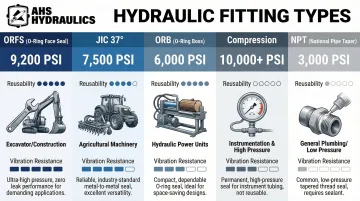
The table below summarizes key specifications to help you select the right fitting type for your application:
| Fitting Type | Pressure Rating | Reusability | Best Application | Vibration Resistance |
|---|---|---|---|---|
| ORFS | Up to 9,200 PSI | Excellent | Heavy construction, excavators | Superior |
| JIC 37° | Up to 7,500 PSI | Good | Tractors, moderate-duty equipment | Good |
| ORB | Up to 6,000 PSI | Excellent | Log splitters, frequent service | Very Good |
| Compression | 10,000+ PSI* | Fair | Field repairs, instrumentation | Very Good |
| NPT | Under 3,000 PSI | Poor | Static installations only | Poor |
*Depends on tubing specifications
Material Selection for High-Pressure Systems
Stainless Steel: Grades 304 vs. 316
Stainless steel delivers superior corrosion resistance and the highest pressure ratings, but grade selection matters for specific environments.
Type 316 stainless advantages:
- Retains 96% of pressure rating at 400°F vs. 94% for 304 stainless
- Superior resistance to pitting and crevice corrosion in marine applications
- Better performance in warm chloride environments
When to specify 316:
- Coastal or marine equipment
- Chemical processing applications
- High-temperature systems above 300°F
- Corrosive fluid handling
When 304 works:
- Indoor industrial applications
- Operations below 300°F
- Non-corrosive hydraulic fluids
Carbon Steel: Strength at Lower Cost
Carbon steel (typically 12L14) remains the standard for general hydraulic applications, offering excellent strength-to-cost ratio.
It requires zinc plating or similar coating for corrosion protection and operates reliably from -65°F to +400°F.
Best applications:
- General-purpose industrial hydraulic circuits
- Construction equipment in non-marine environments
- Systems where cost control is critical
- Circuits with regular maintenance access
Brass: Limited High-Pressure Use
Brass fittings typically max out at 3,000 PSI, with many rated for lower working pressures.
While offering excellent machinability and natural corrosion resistance, brass lacks the strength required for most high-pressure hydraulic circuits in heavy machinery.
Appropriate applications:
- Auxiliary circuits under 2,000 PSI
- Instrumentation connections
- Low-pressure lubrication systems
Critical limitation: Not recommended for primary hydraulic circuits in log splitters, excavators, or other high-pressure equipment.
Quality Control and Material Sourcing
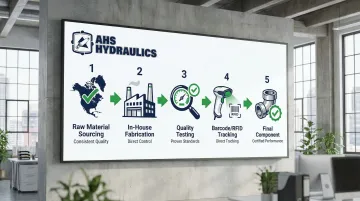
Material quality directly impacts fitting reliability in demanding hydraulic systems. HydraWolf Hydraulics sources all raw materials from North America and fabricates the majority of components in-house at their two American facilities.
This approach delivers three key advantages:
- Consistent material quality across all components
- Direct tracking from raw material to finished fitting
- Proven designs combined with innovative hydraulic functions for applications from firewood processing to heavy construction equipment
Advanced tracking systems using barcodes and RFID enable manufacturers to monitor material compliance and pressure ratings, ensuring only components meeting specific safety standards enter service. Mixing fittings from different suppliers increases failure risk due to incompatible tolerances.
Understanding Pressure Ratings and Standards
Working Pressure vs. Burst Pressure
Working pressure defines the pressure a fitting is designed to handle throughout its entire service life under dynamic conditions. Burst pressure represents the static pressure at which catastrophic failure occurs.
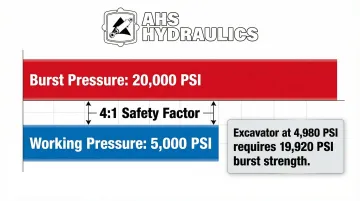
The industry standard mandates a 4:1 safety factor for dynamic hydraulic applications—burst pressure must be at least four times the working pressure.
For example, a fitting rated for 5,000 PSI working pressure must withstand 20,000 PSI burst pressure.
John Deere excavators operate travel circuits at 4,980 PSI. Fittings in these circuits require minimum 19,920 PSI burst strength.
That means ORFS or high-grade JIC fittings are necessary.
Key Industry Standards
SAE J514 governs hydraulic tube fittings including 37° flare and flareless types. Compliance requires passing one million pressure cycles at 133% of working pressure.
This confirms fatigue resistance under real-world conditions.
ISO 8434 covers international fluid power connections:
- ISO 8434-2: 37° flare fittings
- ISO 8434-3: O-ring face seal (ORFS) fittings
Purchasing from manufacturers following these standards ensures compatibility across equipment brands and prevents failures from substandard components.
Environmental Derating Factors
Operating conditions significantly impact actual pressure capacity. Understanding these factors helps prevent unexpected failures.
Temperature affects material strength:
- At 400°F, steel fittings drop to 86% of rated capacity
- Brass drops to 50% capacity at elevated temperatures
- Cold temperatures below -20°F can make some materials brittle
Severe vibration environments require additional safety margin. Equipment like excavators, bulldozers, and mobile log splitters experience constant shock loads that accelerate wear.
Abrasive particles in hydraulic fluid erode sealing surfaces over time, reducing effective pressure capacity. Regular fluid filtration extends fitting life.
Selecting the Right Fitting for Your Application
Start With System Pressure Requirements
Determine maximum operating pressure from equipment specifications, then add a safety margin.
Log splitters like NorthStar units operate at 3,500 PSI, requiring fittings rated for minimum 3,500 PSI working pressure (14,000 PSI burst). Excavator systems reaching 4,980 PSI need ORFS fittings rated for 6,000+ PSI working pressure.
Construction equipment varies widely. Verify pressure specs in operator manuals or contact manufacturers—never guess. Undersized fittings cause catastrophic failures.
Consider Connection Frequency
Seasonal equipment and machinery requiring regular maintenance need different fittings than permanent installations:
Frequent disconnection:
- Choose SAE ORB fittings with replaceable O-rings
- Avoid NPT—thread distortion worsens with each cycle
- Consider quick-disconnect couplings for very frequent service
Permanent installations:
- NPT or welded connections may be cost-effective
- JIC fittings work well for semi-permanent setups
- Prioritize initial installation quality over reusability
Evaluate Environmental Conditions
Environmental factors directly impact fitting longevity and system reliability.
Marine or coastal equipment requires 316 stainless steel for salt exposure. Inspect fittings monthly for corrosion and apply protective coatings to carbon steel components.
Extreme temperatures demand material adjustments. Use stainless steel above 300°F and verify O-ring compatibility—Viton handles high heat, while Buna-N works for standard conditions. Account for derating factors in pressure calculations.
Mobile equipment operating in high-vibration environments performs best with ORFS fittings. Add tube clamps every 18-24 inches to reduce stress and inspect connections weekly on severe-duty machinery.
Match Fitting Size and Thread Type
Undersized fittings create pressure drops and flow restrictions. Oversized fittings add unnecessary weight and cost.
Common thread types include:
- JIC: 37° flare with straight threads
- ORB: Straight threads with O-ring groove
- NPT: Tapered threads requiring sealant
- ORFS: Flat face with O-ring groove
Never mix incompatible thread types. A JIC male won't seal properly on an NPT female port, even if threads engage.
Factor in Maintenance Accessibility
Choose fittings allowing easier inspection and replacement in hard-to-reach locations:
- 90-degree elbows reduce hose stress in tight spaces
- Straight fittings simplify inspection and torque verification
- Consider wrench clearance during initial design
Total Cost of Ownership
The upfront fitting cost is just one piece of long-term ownership expenses.
Buying direct from manufacturers offers:
- Correct part selection from technical experts
- Quality assurance through controlled manufacturing
- Technical support from designers and builders
- Reduced downtime from proper specifications
At HydraWolf, the team includes heavy machine operators who've dealt with fitting failures firsthand. This means you get recommendations based on real-world experience, not just spec sheets—and you're working directly with the people who design and build the components.
Installation Best Practices for High-Pressure Fittings
Thread Preparation and Cleaning
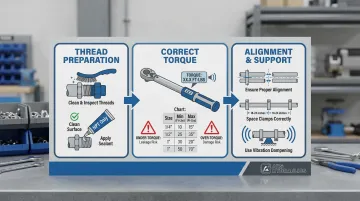
Before assembly, remove all debris, burrs, and old sealant from fittings. Use a wire brush for threads and clean rags for sealing surfaces.
Contamination causes 15% of hydraulic system failures.
Sealant requirements:
- NPT fittings: Apply thread sealant tape 1.5-2 turns clockwise, leaving first two threads bare to prevent contamination
- ORB and ORFS fittings: Never use thread sealant—the O-ring provides the seal, threads only provide clamping force
- JIC fittings: No sealant needed; metal-to-metal flare creates the seal
Correct Torque Specifications
Improper torque causes 60% of hydraulic leaks. Manufacturer specifications vary by fitting type and size, so always consult torque charts for your specific application.
| Fitting Size | JIC 37° Flare | ORFS | NPT (TFFT Method) |
|---|---|---|---|
| -4 (or up to 1/2") | 11-12 lb-ft | 18 lb-ft | 2-3 turns |
| -8 | 25-30 lb-ft | — | — |
| -12 | — | 75 lb-ft | — |
| -16 | 95-105 lb-ft | — | — |
| -24 | — | 230 lb-ft | — |
| -32 | 245-258 lb-ft | 375 lb-ft | — |
| Larger than 1/2" | — | — | 1.5-2.5 turns |
Note: NPT connections use "Turns From Finger Tight" (TFFT) method rather than torque values.
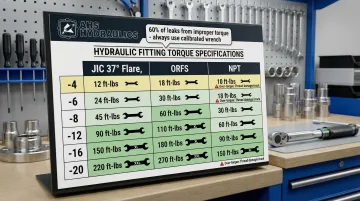
Under-torquing creates insufficient clamping force, allowing leakage either immediately or after vibration loosens the connection.
Over-torquing causes different damage depending on fitting type:
- JIC: Collapses cone or cracks flare, restricting flow
- ORFS: Deforms threads and stretches metal, reducing clamping force
- NPT: Cracks ports permanently, destroying the component
Always use calibrated torque wrenches for critical connections. Never estimate torque by feel.
Alignment and Support
Proper alignment is critical to fitting longevity. Misaligned tubing creates stress on fittings, causing fatigue and premature leakage.
Bend tubing to the correct angle before installation—never force misaligned tubes into fittings.
Install adequate support:
- Install clamps every 18-24 inches on unsupported runs
- Use vibration-dampening clamps on mobile equipment
- Allow for thermal expansion in long runs
- Avoid sharp bends that stress fittings
Vibration and unsupported weight are primary causes of fitting fatigue failure in construction and agricultural equipment.
Maintenance and Troubleshooting High-Pressure Fittings
Inspection Schedule
Inspection frequency should match application intensity:
- Daily: Visual check for leaks and damage during pre-operation inspections
- Weekly: Detailed visual inspection for severe-duty applications (excavators, commercial log splitters)
- Monthly: Comprehensive inspection for normal service conditions
- Severe duty: Increase frequency by 25-50% for harsh environments
Look for fluid weeping, corrosion, thread damage, and fitting movement during inspection.
Common Failure Modes
Understanding failure patterns helps you respond quickly when issues arise.
Leaking (most common):
- Causes: Improper installation (60%), worn O-rings, corrosion, vibration loosening
- Solution: Check torque first, then inspect O-ring and sealing surfaces
Fitting slippage:
- Indicates critical failure of hose-to-fitting interface requiring immediate replacement—never attempt repair
Cracking or corrosion:
- Visible cracks or heavy corrosion require immediate replacement
- Don't wait for leakage to develop
Replace vs. Repair Criteria
When components fail, knowing whether to repair or replace prevents costly downtime.
Always replace, never repair:
- Failed hose assemblies
- Fittings with visible cracks or thread damage
- Components with scratched sealing surfaces
- O-rings during any disassembly (reusing O-rings causes maintenance-induced leaks)
When re-torquing may work:
- Recent installation that's begun weeping
- Fittings loosened by vibration with undamaged threads
- Connections that haven't reached service life limits
Critical Safety Protocol: Depressurization
Simply turning off machinery doesn't eliminate stored energy. Cylinders and accumulators trap pressure that remains dangerously high even after shutdown.
Before loosening any fitting:
- Follow manufacturer's specific depressurization procedures
- Relieve pressure from all circuits
- Verify zero pressure with gauges
- Never use hands to check for leaks (high-pressure fluid causes injection injury)
- Use cardboard or paper to detect leaks safely
A leak rate of just one drop per second wastes 3,000 gallons of fluid annually, but more importantly, indicates a developing failure that could cause injury.
Frequently Asked Questions
What are high-pressure fittings?
High-pressure fittings are specialized connectors engineered for hydraulic systems operating above 3,000 PSI, featuring thicker walls, deeper threads, and robust sealing mechanisms (O-rings or metal-to-metal contact) to prevent leaks and failures under extreme force and vibration.
What fitting can handle the highest pressure?
SAE O-Ring Face Seal (ORFS) fittings typically handle the highest pressures, with ratings up to 9,200 PSI dynamic and 12,000 PSI static. Actual capacity depends on size, material, and manufacturer, with stainless steel ORFS fittings offering maximum pressure capability.
Which metals are best suited for high-pressure hydraulic systems?
Stainless steel grades 304/316 offer superior strength and corrosion resistance, with 316 maintaining 96% pressure rating at 400°F. Carbon steel provides excellent strength at lower cost, while brass is limited to applications under 3,000 PSI.
Which type of tubing is best for applications where high-pressure strength is required?
Seamless steel tubing (carbon or stainless) is preferred due to superior burst strength and fatigue resistance. Wall thickness and grade must match pressure requirements—welded tubing requires 0.80-0.85 derating factors.
How do I know when to replace hydraulic fittings?
Replace fittings immediately when they show visible corrosion, cracking, thread damage, or persistent leaking after proper re-torquing. Also replace after multiple assembly/disassembly cycles that may have degraded sealing surfaces, and always replace O-rings during any disassembly.
Why choose American-made hydraulic fittings over imported alternatives?
American-made fittings adhere to stricter quality standards (SAE J514, ISO 8434), use higher-grade materials with better traceability, and offer superior technical support. Purchasing direct from manufacturers like HydraWolf ensures you receive correct parts with rigorous quality control through in-house fabrication.