Introduction
Incorrect valve selection in skid-based fluid routing systems leads to system failures, costly downtime, and serious safety hazards. In mobile and industrial hydraulic applications operating at 3,000 to 6,000 PSI, a single valve failure halts operations and creates dangerous pressure spikes.
Skid-mounted systems present unique challenges that standard piping applications don't face: severe space constraints, integration with pre-assembled components, vibration resistance during transport, and reliable performance in heavy machinery from firewood processors to construction equipment.
These compact, transportable units demand components that deliver maximum functionality within minimal footprints while technicians can access them for field maintenance.
To address these challenges, this guide covers:
- Valve types specifically suited to skid applications
- Selection criteria that balance specifications with operational requirements
- Decision-making frameworks connecting valve performance to system reliability and total cost of ownership
Key Takeaways
- Valves control flow, pressure, and direction in compact skid-mounted hydraulic units (3,000-6,000 PSI)
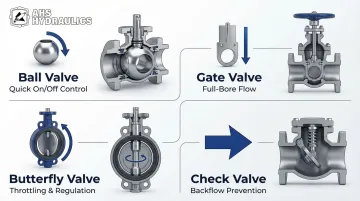
- Four primary types: ball (on/off), gate (full-bore flow), butterfly (throttling), check (backflow prevention)
- Key selection factors: pressure/temperature ratings, fluid compatibility, mounting space, and flow coefficient
- Right valve choice reduces downtime by 40% and cuts maintenance costs in heavy machinery applications
What Are Valves in Skid-Based Fluid Routing?
Valves are mechanical devices that regulate, direct, or control fluid flow within skid-mounted hydraulic systems used in heavy machinery, agricultural equipment, and industrial applications.
These engineered components serve as control points, determining when, where, and how hydraulic fluid moves through the system to power cylinders, motors, and other actuators.
In skid-based systems—pre-assembled, transportable units—valves face unique operational demands. These modular power units must operate reliably in compact spaces while maintaining accessibility for maintenance.
Unlike stationary plant piping, skid-mounted equipment endures:
- Transport vibration and shock loads during relocation
- Dynamic pressure fluctuations from mobile operation
- Strict space constraints requiring compact valve designs
- Environmental exposure to dust, moisture, and temperature extremes
For example, a firewood processor or log splitter skid experiences constant vibration and pressure spikes that stationary systems never encounter.
Why Skid Valve Selection Differs
Choosing valves for skid-based systems requires a different approach than selecting for stationary piping. Key considerations include:
- Integration requirements: Valves must fit within pre-designed manifolds and mounting brackets
- Spatial limitations: Every inch counts in compact skid layouts
- Vibration resistance: Components must withstand continuous movement
- Service accessibility: Technicians need to reach valves for maintenance without disassembling the entire skid
A valve that works perfectly in a stationary plant installation can fail within months on a mobile skid. The difference lies in the environment: skid-mounted equipment operates under continuous vibration, pressure spikes, and temperature swings that exceed typical plant conditions.
Core Valve Types for Skid-Based Fluid Routing Systems
Different valve types serve distinct functions in skid systems, and understanding their operating mechanisms helps match the right valve to specific routing requirements.
Each type offers unique advantages and limitations that must align with your application's pressure, flow, and control needs.
Ball Valves
Ball valves use a quarter-turn mechanism with a rotating spherical closure element that provides quick on/off control with minimal pressure drop. When the ball rotates 90 degrees, it either aligns the bore with the flow path (fully open) or positions the solid portion perpendicular to flow (fully closed).
Trunnion-mounted designs eliminate shear failure common in two-piece constructions, making them suitable for high-pressure applications.
Applications ideal for skid systems:
- Fast shut-off requirements in hydraulic power units
- Tight sealing in high-pressure systems (up to 20,000 PSI burst ratings)
- Frequent operation cycles without performance degradation
- Systems requiring reliable isolation between maintenance intervals
Advantages for skid mounting:
- Compact design requires minimal installation space
- Quarter-turn actuation allows fast response and positive stopping
- Full-port designs minimize pressure drop across the valve
- Suitable for various fluid media including hydraulic oils
- Temperature ratings from 0°F to 400°F with standard FKM seals
- Easy automation with pneumatic or electric actuators
Gate Valves
Gate valves employ a sliding gate mechanism that moves linearly to block the flow path.
When fully open, they provide full-bore, unobstructed flow with virtually no pressure drop. This makes them ideal for applications requiring maximum flow capacity without restriction.
Typical use cases:
- Systems where throttling is not required but complete isolation is essential
- Applications prioritizing maximum flow capacity over flow control
- Infrequent operation scenarios (open/closed service rather than regulation)
Skid-specific considerations:
- Require more vertical space for stem travel compared to quarter-turn valves
- Multi-turn operation makes them slower to actuate than ball or butterfly valves
- Work best for isolation service rather than constant flow regulation
- Generally not recommended for frequent cycling in mobile hydraulics
Butterfly Valves
These valves feature a rotating disc mechanism. They handle both shut-off and throttling while maintaining a compact footprint. The disc rotates on a central shaft, with the disc edge sealing against the valve body in the closed position. Even when fully open, the disc remains in the flow path.
Advantages for skid systems:
- Lightweight construction reduces overall skid weight
- Space-efficient design ideal for larger line sizes
- Cost-effective compared to ball or gate valves in larger diameters
- Suitable for flow regulation and throttling applications
- ISO 5211 standardized mounting allows direct actuator attachment
Limitations to consider:
- May not provide bubble-tight shut-off like ball or gate valves
- Disc remains in flow path even when fully open, creating some restriction
- Pressure drop increases in partially open positions
- Seal wear can occur more rapidly in throttling applications
Check Valves
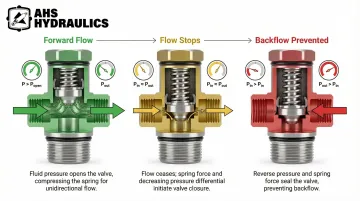
Check valves operate automatically to prevent backflow, protecting pumps and other equipment from reverse flow damage. These valves open when forward flow exceeds the cracking pressure and close when flow stops or reverses, requiring no external control or actuation.
Critical applications in skid systems:
- Protecting hydraulic pumps from reverse rotation and damage
- Preventing system drainage when equipment is shut down
- Maintaining pressure in specific circuit branches
- Anti-cavitation protection during motor coast-down
Types commonly used in skids:
- Swing check valves: Gravity-assisted closure, orientation-dependent
- Lift check valves: Spring-loaded for positive sealing, may have orientation restrictions
- Spring-loaded poppet valves: Flexible mounting, cracking pressures from 1/3 PSI to 25 PSI
- Anti-cavitation check valves: Allow fluid bypass to prevent vacuum formation
What to Consider When Selecting Valves for Skid-Based Fluid Routing
Valve selection must balance technical requirements with practical operational needs specific to skid-mounted systems. The following factors help engineers and operators connect valve specifications to actual performance, reliability, and total cost of ownership in demanding mobile applications.
Operating Pressure and Temperature Ratings
Matching valve pressure ratings to system operating and peak pressures prevents system failures and ensures safe operation. Mobile construction equipment and hydraulic power units typically operate between 3,000 and 5,000 PSI.
Systems experience dynamic pressure fluctuations and shock loads that can exceed nominal operating pressures.
Pressure considerations:
- Standard hydraulic systems: 3,000-6,000 PSI working pressure
- Burst pressure ratings should exceed working pressure by 4:1 safety factor (5,000 PSI working = 20,000 PSI burst minimum)
- Components must withstand at least 1 million cycles at rated pressure per NFPA T2.6.1 testing standards
- Pressure spikes during rapid valve closure or pump startup can reach 150-200% of nominal pressure
Temperature ratings must account for both fluid temperature and ambient conditions, especially for outdoor or mobile skid installations. Standard FKM (Viton) seals in ball valves can handle temperatures from -18°C to 204°C.
Reservoir temperatures in open systems should not exceed 50°C to prevent fluid aging and water loss in water-containing fluids. Cold-start conditions in outdoor applications may require valves rated for sub-zero operation without seal hardening or cracking.
Fluid Media Compatibility
Beyond pressure and temperature, material compatibility determines long-term valve reliability. Different fluids require specific valve materials and seal types to prevent corrosion, erosion, or seal degradation. Hydraulic oils, water-glycol mixtures, fire-resistant fluids, and abrasive slurries each present unique compatibility challenges.
Material selection examples:
- Stainless steel bodies: Corrosive media, chemical applications, marine environments
- Brass/bronze construction: Water applications, lower-pressure systems
- Carbon steel: Standard hydraulic oils, cost-effective for non-corrosive fluids
- Zinc/galvanized finishes: Incompatible with some water-containing fluids (HFC), can form soaps that block filters
Seal material compatibility:
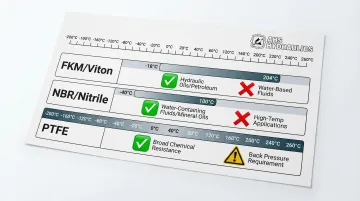
| Seal Material | Temperature Range | Compatible Fluids | Incompatible Fluids |
|---|---|---|---|
| FKM (Viton) | -18°C to 204°C | Hydraulic oils, petroleum products | Water-containing fluids (HFA, HFC) |
| NBR (Nitrile) | -40°C to 100°C | Water-containing fire-resistant fluids, mineral oils | High-temperature applications |
| PTFE | -200°C to 260°C | Broad chemical resistance | May require back pressure for sealing |
Fluid viscosity also affects valve selection. Thicker fluids increase pressure drop across valves and may require larger ports or higher actuation forces.
High viscosity at low temperatures can lead to cavitation if flow paths are restricted, causing metal erosion and component failure.
Space Constraints and Mounting Configuration
Physical dimensions become a primary concern in skid-mounted systems with limited space. Skid-mounted systems require careful consideration of valve dimensions, actuation clearance, and maintenance access. ISO 5211 standards define flange and drive dimensions for part-turn actuators, allowing compact, direct mounting without bulky brackets.
Dimensional considerations:
- Valve body size and weight
- Actuator mounting space (pneumatic or electric)
- Wrench clearance for manual operation and maintenance
- Vertical space for gate valve stem travel
- Horizontal space for lever handles on ball valves
Valve orientation affects both installation and performance, particularly for check valves.
Lift-type check valves may have orientation restrictions requiring vertical mounting for gravity assistance, while spring-loaded poppet valves allow flexible mounting but require sufficient cracking pressure to overcome spring tension.
Compact valve designs like ball or butterfly valves are often preferred over gate valves in space-limited skid applications. For example, a butterfly valve can replace a gate valve in a 6-inch line while reducing weight by 40-60% and requiring 70% less installation length.
Flow Control Requirements
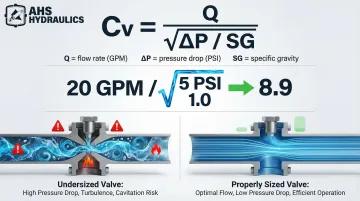
Properly sizing valves prevents bottlenecks that waste energy and damage components. Distinguish between applications requiring simple on/off control versus those needing precise flow regulation or throttling capabilities. The flow coefficient (Cv) represents the volume of water in US gallons per minute (GPM) that flows through a fully open valve with a 1 PSI pressure drop at 60°F.
Cv calculation formula: Cv = Q / √(ΔP / SG)
Where:
- Q = flow rate in GPM
- ΔP = pressure drop in PSI
- SG = specific gravity of fluid
Impact of undersized valves:
- Creates bottlenecks that restrict system flow capacity
- Excessive pressure drop generates heat and wastes energy
- Can lead to cavitation when static pressure drops below vapor pressure
- Reduces component life through frequent pump cycling
- Causes banging noises and physical damage to components
For a system requiring 20 GPM flow with maximum acceptable pressure drop of 5 PSI, the minimum Cv would be: Cv = 20 / √(5 / 1.0) ≈ 8.9. Selecting a valve with Cv of 10 or higher ensures adequate flow capacity with safety margin.
Some applications may require pressure-regulating or flow-control valves rather than simple isolation valves, particularly in circuits where maintaining consistent pressure or flow rate is essential for equipment protection or process control.
Maintenance Accessibility and Serviceability
Downtime costs money. Skid systems must allow for valve maintenance without complete system disassembly, making valve placement and design essential. Field maintenance scenarios demand components that can be serviced quickly with standard tools and readily available replacement parts.
Serviceability features to prioritize:
- Replaceable seals, packing, or trim components that can be serviced in the field
- Re-torqueable seat glands that extend service life
- Bolted bonnet designs allowing access to internal components
- Standard seal sizes available from multiple suppliers
- Clear maintenance documentation with exploded views and part numbers
Quarter-turn valves (ball, butterfly) offer easier operation and maintenance compared to multi-turn valves (gate). A ball valve can be cycled in seconds for testing, while a gate valve may require dozens of turns to fully open or close.
Valve orientation and surrounding component placement should allow for wrench access and potential valve removal if needed. ISO 6162 flange connections facilitate component removal without cutting pipes, reducing maintenance downtime.
System Integration and Standardization
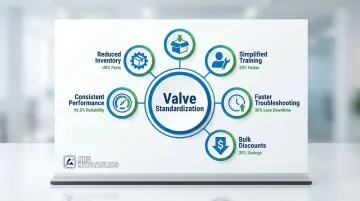
Using consistent components across your skid system simplifies operations and reduces costs. Standardizing on specific valve types, sizes, and manufacturers across a skid system simplifies spare parts inventory and maintenance training. When every valve is a different brand or model, maintaining adequate spare parts becomes expensive and complex.
Benefits of standardization:
- Reduced spare parts inventory costs
- Simplified maintenance training for operators
- Faster troubleshooting with familiar components
- Bulk purchasing discounts from single-source suppliers
- Consistent performance characteristics across the system
End connection considerations:
- Threaded connections: NPT, JIC, ORB for smaller sizes (typically under 1 inch)
- Flanged connections: ISO 6162 / SAE J518 for high-pressure lines (35-350 bar)
- Welded connections: Permanent installations where removal is not anticipated
ISO 6149 metric ports with O-ring sealing are recommended for new hydraulic fluid power designs to ensure leak-free performance up to 630 bar. These standardized connections minimize leak points and simplify component replacement.
Consider automation compatibility if the skid system may be upgraded with remote or automated control in the future. Valves adhering to ISO 5211 mounting standards can accept actuators from multiple manufacturers, providing flexibility for future upgrades without valve replacement.
Select valves from manufacturers with strong technical support and readily available replacement parts to reduce long-term operational risks. A valve that saves $50 initially but requires a 2-week lead time for replacement parts can cost thousands in downtime.
How HydraWolf Hydraulics Can Help
HydraWolf Hydraulics manufactures American-made hydraulic components specifically engineered for reliability in heavy machinery and skid-based fluid routing applications.
As a subsidiary of Automated Biomass Systems, HydraWolf brings over a decade of experience in hydraulic systems for demanding applications from firewood processing equipment to construction machinery.
HydraWolf's unique position as a direct manufacturer eliminates middleman costs, providing customers with manufacturer-level pricing on high-quality hydraulic valves and components.
HydraWolf sources all raw materials from North America and fabricates most hydraulic components in-house at two American manufacturing facilities, ensuring rigorous quality control through continuous monitoring and testing.
This direct-manufacturer approach delivers specific advantages for skid-based applications:
- Direct manufacturer pricing eliminates distribution markups
- Technical support from the engineers and builders who design and manufacture the components
- Proven performance in demanding applications including mobile equipment and industrial systems
- Comprehensive valve selection including single-spool and two-spool directional control valves, auto-cycle valves with NPT ports, and specialized configurations for compact installations
- Complete system integration support with extensive hydraulic fittings inventory (JIC, ORB, NPT connections) for seamless valve installation
HydraWolf's combination of tried-and-tested designs with innovative hydraulic functions ensures customers get reliable components that meet both current needs and future operational demands.
The experienced team consists of professionals who operate heavy machinery themselves, providing practical expertise that connects technical specifications to real-world performance requirements.
Conclusion
Successful valve selection for skid-based fluid routing requires balancing technical specifications with practical operational needs like space constraints, maintenance accessibility, and system integration requirements.
The most expensive or technologically advanced valve isn't always the right choice. Your goal: match component capabilities to specific pressure, flow, and reliability requirements for your application.
Understanding how these specifications interact determines overall system performance. Operating pressure ratings, fluid compatibility, flow coefficients, and mounting configurations all work together.
A valve that excels in one area but falls short in another can become the weak link that compromises entire system reliability. If you need guidance matching valve specs to your specific application, HydraWolf's team provides direct technical support from the engineers who design hydraulic systems.
Proper valve selection is an ongoing process rather than a one-time decision. As skid systems evolve, applications change, or operating conditions shift, periodic review keeps your system running efficiently.
Regular evaluation identifies upgrade opportunities that improve reliability and performance:
- Review maintenance records to spot recurring valve issues
- Track failure patterns to identify weak points before they cause downtime
- Monitor performance metrics against baseline specifications
- Evaluate new valve technologies that could boost system efficiency
Frequently Asked Questions
What is the difference between ball valves and gate valves for skid-based systems?
Ball valves offer quick quarter-turn operation and compact design ideal for frequent cycling and tight spaces. Gate valves provide full-bore flow with no obstruction but require more vertical space and multi-turn actuation, making them best for infrequent on/off service.
Can I use the same valve for different fluid types in my skid system?
It depends on material and seal compatibility. Stainless steel bodies with PTFE seals can handle multiple fluids, but verify compatibility to prevent corrosion or seal degradation. For example, FKM seals work with hydraulic oils but not water-based fluids, which require NBR seals.
How do I determine the correct valve size for my skid-based fluid routing?
Size valves based on required flow rate, acceptable pressure drop, and flow coefficient (Cv) using the formula Cv = Q / √(ΔP / SG). Undersized valves create bottlenecks, while oversized valves add cost and reduce control effectiveness at low flow rates.
What maintenance should I perform on valves in skid-mounted systems?
Perform visual leak inspections, periodic cycling to prevent seizing, and seal integrity checks. Maintenance intervals vary by valve type and operating conditions—ball valves typically require less maintenance than gate valves due to simpler construction.
Are automated valves worth the investment for skid systems?
Yes, when remote operation, frequent cycling, or system integration is required. While initial costs run 2-3 times higher than manual valves, automated valves reduce labor, improve response times, and eliminate operator error in critical applications.
How does operating pressure affect valve selection for hydraulic skid systems?
Valve pressure ratings must exceed maximum system pressure with adequate safety margin (typically 4:1) to account for transient spikes. Hydraulic systems often experience pressure surges 150-200% above normal levels during rapid actuator movement or pump startup, so rating for nominal pressure alone risks catastrophic failure.