Introduction
Hydraulic systems drive the heavy machinery that keeps firewood processing, construction, agriculture, and marine operations running. Operating at 2,000-3,000 PSI, these systems deliver the force needed to split hardwood logs, lift tons of material, and power precise movements in demanding environments.
This power requires consistent maintenance. Without it, you face unexpected downtime, emergency repairs, safety hazards, and shortened equipment life.
The stakes are high: industry data shows contamination causes 70-90% of hydraulic failures, often degrading performance by 16-20% before operators notice problems.
This guide covers everything you need to know about hydraulic system maintenance in 2026: why it matters, the four maintenance types, how to spot warning signs early, scheduling guidelines, and common mistakes that compromise performance and safety.
Key Takeaways
- Regular maintenance extends equipment life by 30-50% and prevents costly downtime
- Choose from four maintenance approaches: preventive, corrective, predictive, or major overhaul
- Watch for unusual noises, leaks, temperature spikes, slow operation, and oil contamination
- Match maintenance frequency to usage intensity for optimal performance
- Clean fluid prevents 70-90% of hydraulic failures
Why Maintenance of Hydraulic Systems Is Important
Operating Under Extreme Pressure
Hydraulic systems work under tremendous stress, with industrial equipment typically operating between 2,000-3,000 PSI, and some heavy equipment sensors monitoring pressures up to 9,000 PSI.
This extreme pressure environment makes maintenance critical—small issues quickly escalate into major failures when components operate under such demanding conditions.
Performance and Efficiency Impact
Poorly maintained hydraulic systems suffer significant efficiency losses that directly affect your bottom line:
- Systems can lose 16-20% efficiency due to internal leakage and wear before operators notice performance drops
- Hydraulic leaks and inefficiencies increase fuel consumption by 10-15%
- Contaminated fluid causes abrasive wear that reduces volumetric efficiency
These efficiency losses translate to longer cycle times, increased fuel costs, and reduced productivity across your operation.
Equipment Lifespan Extension
Regular maintenance dramatically extends component life:
- Gear pumps: 5,000-10,000 hours (up to 15,000 in clean systems)
- Vane pumps: 10,000-15,000 hours
- Piston pumps: 15,000-20,000+ hours under optimal conditions
- Optimizing oil change intervals and maintaining cleanliness can extend hydraulic component life by 40%
Safety and Compliance Requirements
Beyond equipment performance, maintenance directly impacts operator safety and regulatory compliance.
OSHA mandates specific hydraulic safety measures:
- Periodic hose inspections and proper component selection
- Machine guarding (29 CFR 1910.212) for hazardous hydraulic components
- Lockout/Tagout procedures (29 CFR 1910.147) during maintenance
Hydraulic injection injuries are severe. Fluid can penetrate skin at pressures as low as 100 PSI. Between 2012 and 2021, there were approximately 15,307 high-pressure injection injuries to hands in the U.S.
While historical data cited amputation rates of 35-80%, recent studies show this can be reduced to ~2.2% with immediate, specialized surgical treatment.
Beyond operator safety, environmental regulations carry heavy penalties. Any oil spill creating a "sheen" on water must be reported federally. In California, criminal penalties for oil spills include fines of $10,000 to $1,000,000, plus up to $1,000 per gallon spilled for volumes exceeding 1,000 gallons.
Cost Savings Analysis
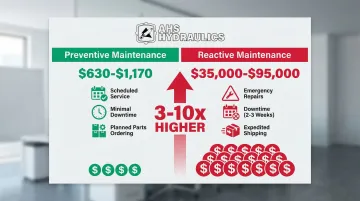
The ROI of preventive maintenance versus reactive repairs is compelling:
| Approach | Cost | Impact |
|---|---|---|
| Preventive fluid service | $630-$1,170 | Scheduled, minimal downtime |
| Reactive system overhaul | $35,000-$95,000 | Emergency labor, expedited parts, 2-3 weeks downtime |
| Cost multiplier | Baseline vs. 3-10x higher | Reactive maintenance costs 3-10 times more |
A simple example: $500 in annual preventive maintenance prevents $5,000+ in emergency repairs. When you factor in downtime costs of $1,200-$2,400 per hour and rental equipment at $300-$3,000 per day, the financial case for preventive maintenance becomes overwhelming.
Types of Maintenance for Hydraulic Systems
Different maintenance approaches serve different purposes and can be combined for optimal results. Understanding each type helps you build a comprehensive maintenance strategy.
The four primary maintenance approaches—preventive, reactive, predictive, and major overhaul—each play a distinct role in keeping hydraulic systems operational. Here's how they compare in practice.
Routine/Preventive Maintenance
Preventive maintenance involves scheduled inspections and upkeep performed at regular intervals regardless of system condition. This proactive approach catches small issues before they become expensive failures.
Typical tasks include:
- Fluid level checks and quality assessment
- Filter replacements per manufacturer schedule
- Visual inspections for leaks and damage
- Temperature monitoring during operation
- Seal examinations and fitting torque checks
This approach works best for:
- High-use equipment operating 8+ hours daily
- Critical operations where downtime is costly
- Warranty compliance requirements
Average costs run $300-800 per service depending on equipment size and complexity.
Corrective/Reactive Maintenance
This "fix it when it breaks" approach addresses problems after they occur—component failure, system shutdown, or performance degradation triggers action. While sometimes unavoidable for unexpected issues, the risks add up quickly:
Key risks:
- Repair costs 3-10x higher than preventive approaches
- Extended downtime of 24-72 hours waiting for parts
- Potential for chain-reaction failures affecting multiple components
- Safety hazards from unexpected equipment failure
- Contamination events requiring system-wide cleaning (300-500% cost increase)
Predictive/Condition-Based Maintenance
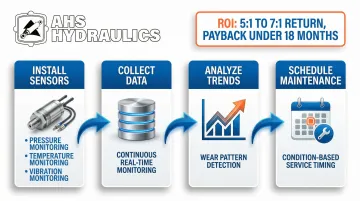
Predictive maintenance uses real-time monitoring and data analysis to schedule maintenance based on actual component condition rather than fixed time intervals. Instead of changing filters every 500 hours regardless of condition, you replace them when sensors indicate degradation.
Common monitoring methods:
- Oil analysis for contamination and wear particles
- Vibration sensors detecting mechanical issues
- Temperature tracking identifying overheating
- Pressure monitoring revealing internal leakage
- Flow meters measuring efficiency losses
The upfront investment pays for itself quickly. Initial sensor systems cost $1,000-5,000, with ongoing oil analysis running $50-75 per sample. In return, you'll see maintenance costs drop 10-40% and unplanned downtime decrease 35-50%. Most operations achieve 5:1 to 7:1 ROI with payback under 18 months—meaning a $3,000 sensor investment saves $15,000-21,000 over that period.
Major Overhaul/Rebuild Maintenance
Comprehensive servicing involves cylinder rebuilds, pump replacements, valve refurbishment, and complete system flushing. These extensive procedures become necessary:
- After 8,000-10,000 operating hours
- Following contamination events
- When multiple components show significant wear
- During planned equipment refurbishment
Budget accordingly—these aren't minor expenses:
- Hydraulic pumps: $1,500-$5,000
- Main control valves: $2,000-$8,000
- Full system overhaul: $35,000-$95,000
- OEM remanufactured parts can cost up to 35% less than new
How to Check If Hydraulic Systems Need Maintenance
Early detection prevents catastrophic failures that can sideline equipment for days and cost thousands in emergency repairs. Watch for these warning signs that indicate your hydraulic system needs attention.
Performance or Output Changes
Reduced efficiency indicators:
- Slower cycle times completing the same tasks
- Decreased lifting capacity or holding force
- Longer response times when activating functions
- Inability to reach full extension under load
Inconsistent operation:
- Equipment works fine when cold but struggles when warm
- Performance varies unpredictably during operation
- Frequent stalling under normal loads
These performance changes often signal worn seals, contaminated fluid, or failing pumps—issues that worsen rapidly without intervention.
Unusual Behavior or Operation
Abnormal sounds:
- Whining or squealing: Cavitation occurs when pumps receive insufficient fluid supply
- Grinding: Contamination causing abrasive wear
- Knocking or hammering: Air in the system or mechanical failure
- Banging: Worn bearings or couplings
Vibration issues:
- Excessive shaking during operation indicates air entrainment
- Mechanical wear in pumps or motors
- Loose mounting components
Irregular operation:
- Jerky, inconsistent movements
- Unexpected stops mid-cycle
- Functions activating without input
Visible Wear, Errors, or Irregularities
Visual inspection points:
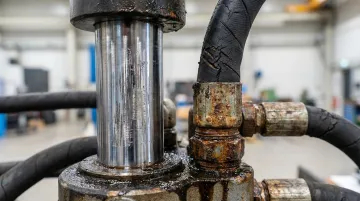
- Scored or pitted cylinder rods
- Cracked, bulging, or abraded hoses
- Corroded fittings or connections
- Fluid residue indicating leaks
- Dashboard warning lights or error codes
Overheating signs:
- Discolored fluid (dark brown or black)
- Burnt smell near hydraulic components
- Components hot to touch (above 180°F)
- Pressure gauge fluctuations
Catching these visual cues early allows you to replace individual components—like cylinders, hoses, or fittings—before they damage the entire system.
Increased Resource Consumption
Energy and fuel usage:
- Fuel consumption spikes of 10-15% from hydraulic inefficiencies
- Equipment requiring longer run times
- Multiple attempts needed to complete standard tasks
Required maintenance actions:
- Frequently adding hydraulic fluid
- Repeatedly resetting systems
- Manually adjusting controls to maintain operation
Even small leaks carry significant costs. A single drop per second wastes 420 gallons of hydraulic fluid annually, costing $1,000+ in lost fluid plus potential environmental fines.
Recurring Issues or Downtime
Pattern recognition:
- Same component failing repeatedly
- Temporary fixes lasting shorter periods each time
- Increasing frequency of unplanned downtime incidents
When temporary solutions indicate deeper problems:
- Repeatedly tightening the same fitting suggests seal or thread damage
- Frequently replacing the same hose indicates routing or pressure issues
- Regular fluid top-ups point to undetected leaks
Track these incidents in a maintenance log to identify trends before they become critical failures.
Hydraulic System Maintenance Schedule (General Guidelines)
Maintenance schedules vary based on equipment type, operating environment (extreme temperatures, dusty conditions), and usage intensity.
Always consult manufacturer specifications first, but use these general guidelines as a foundation.
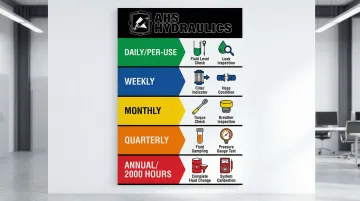
Maintenance Frequency Table
| Frequency | Tasks | Details |
|---|---|---|
| Daily/Per-Use | Fluid level check, leak inspection, sound check | Verify fluid at proper level, look for fresh leaks, listen for unusual noises during startup |
| Weekly | Filter indicator check, hose condition, temperature monitoring | Check filter bypass indicators, inspect hoses for wear/damage, monitor operating temperature under load |
| Monthly | Fastener torque check, breather cap inspection | Tighten fittings per specifications, clean/replace breather caps, check for moisture |
| Quarterly | Fluid sampling, pressure testing, seal examination | Send fluid sample for analysis, test system pressure, inspect seals for wear |
| Annual/2,000 Hours | Complete fluid change, filter replacement, system calibration | Replace all hydraulic fluid, change filters, calibrate pressure settings |
For equipment using HydraWolf Hydraulics components, detailed maintenance schedules are available with direct technical support from engineers who operate the same equipment in real-world applications.
Usage-Based Adjustments
High-usage equipment (8+ hours daily):
- Perform daily checks consistently
- Switch to weekly fluid analysis instead of quarterly
- Reduce standard intervals by 25-50% in severe conditions
- Implement predictive monitoring for critical systems
Low-usage equipment (occasional use):
- Extend intervals cautiously but never skip pre-use inspections
- Change fluid annually even with low hours (fluid degrades over time)
- Inspect for corrosion and moisture during storage
Equipment running continuously (24/7 industrial operations) requires predictive monitoring systems, rotating maintenance windows to avoid production loss, redundant systems for critical functions, and weekly fluid analysis minimum.
Severe operating conditions require interval adjustments:
- High ambient temperatures (>95°F): Reduce intervals by 25-50%
- Dusty environments: Inspect breathers and filters weekly
- Heavy loads: Monitor for overheating and increased wear
Common Hydraulic Maintenance Mistakes to Avoid
Even experienced operators make mistakes that compromise system performance and safety. Avoid these common pitfalls.
Mixing Hydraulic Fluids
Using different oil types or brands causes serious problems:
- Additive conflicts: Different manufacturers use incompatible additive packages that can separate out and form deposits
- Viscosity issues: Mixing grades creates unpredictable flow characteristics
- Seal degradation: Incompatible fluids attack seals, causing premature failure
- Warranty violations: Most manufacturers void warranties if non-specified fluids are used
Given these risks, always verify compatibility before switching fluid types. When changing from mineral oil to synthetic or fire-resistant fluids, consult manufacturers—you may need to replace seals and flush the entire system.
Ignoring Minor Leaks
Even with proper fluid selection, small leaks indicate bigger problems and waste significant resources:
- One drop per second = 420 gallons lost annually
- Fluid replacement costs exceed $1,000 annually
- Environmental fines for soil/water contamination
- Leaks indicate seal failure that will worsen rapidly
- External leaks often accompany internal leakage reducing efficiency
Address leaks immediately—minor drips today become major failures tomorrow.
Neglecting Filter Changes
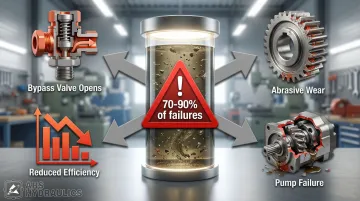
Contamination causes 70-90% of hydraulic failures, making filter maintenance critical.
Clogged filter consequences:
- Bypass valve opens, circulating unfiltered oil
- Contaminants reach sensitive pump and valve components
- Abrasive wear accelerates dramatically
- Catastrophic pump failure can occur rapidly
Watch for these warning signs that filters need immediate replacement:
- Filter bypass indicator activated
- Reduced system pressure
- Increased operating temperature
- Contaminated fluid appearance
Replace filters per manufacturer schedule, not just when indicators show red. Waiting until bypass activation means you've already damaged components.
Conclusion
Hydraulic system maintenance is an investment protecting equipment worth tens of thousands of dollars, not an expense to minimize.
The data is clear: preventive maintenance costs 3-10 times less than reactive repairs, extends component life by 30-50%, and prevents the safety hazards and environmental liability that come with neglected systems.
The most effective approach combines preventive schedules with condition monitoring and prompt corrective action:
- Daily checks catch obvious issues before they escalate
- Scheduled maintenance prevents predictable wear
- Fluid analysis reveals developing problems
- Immediate repairs stop small issues from cascading into major failures
Ready to implement these strategies? Start building your structured maintenance program today using this guide as your foundation. Document your maintenance activities, track recurring issues, and adjust schedules based on your specific operating conditions.
For equipment-specific guidance or technical support with hydraulic components, contact HydraWolf Hydraulics at 607-307-4029 or info@hydra-wolf.com. Their engineering team includes experienced heavy machine operators who understand real-world maintenance challenges.
Frequently Asked Questions
What is the maintenance checklist for hydraulics?
A comprehensive checklist includes daily fluid level and leak checks, weekly filter indicator and temperature monitoring, monthly pressure testing and seal examination, and annual fluid changes with complete system inspection.
What are the 5 main problems in hydraulic systems?
The five most common issues are contaminated fluid (causing 70-90% of failures), overheating, leaking seals and connections, air contamination (causing spongy operation and cavitation), and worn pumps or cylinders.
What are the 4 types of maintenance?
The four maintenance types are Preventive (scheduled routine tasks), Corrective (repair after failure), Predictive (condition-based using monitoring data), and Major Overhaul (comprehensive rebuild at specified intervals).
How often should hydraulic fluid be changed?
Standard intervals are every 1,000-2,000 operating hours or annually for moderate use, though fluid analysis should guide decisions. Contaminated fluid requires immediate change regardless of schedule.
What temperature is too hot for a hydraulic system?
Optimal operating temperature is 110-140°F. Temperatures above 180°F indicate efficiency problems requiring immediate attention, while prolonged operation above 200°F causes rapid component degradation.
Can I use any hydraulic oil in my system?
No—use only manufacturer-specified oil types and viscosity grades. Mixing incompatible fluids damages seals, affects performance, and may void warranties. Always reference your equipment manual for exact specifications.